We know that the dragon is the devil (Revelation 12), so we know that he does not
have royalty or prosperity as his characteristics. Some would argue about
the royalty issue, but consider that Jesus took over ownership of this world when
he died, so
the devil is a squatter
and he knows it. Revelation 12 even tells us that he knows his time here is
short. Before Jesus died, the devil was the owner of this world and its representative
in gatherings in heaven of representatives of the different worlds God has made
(see Job 1 and 2). But, when Jesus died, Satan lost that position. That
is what Revelation 12 means when it tells us that after the death of Jesus (the
time of which is depicted as Jesus being snatched up to God in heaven), the dragon
perceived that he had been hurled to this world and then began pursuing the woman
as a result of his anger. He apparently did this, according to Revelation
12, because he knew that his existence is soon to end. He knew that he had
lost the war for the hearts and minds of other worlds and those angels remaining
in heaven. Thereafter, he was no longer royalty and he he knew he had lost
his position. The bible does say he is the prince of the power of the air,
but that does not make him royalty over all the people of this world. I don't
think we would say he is prospering either considering his future. However,
he does have iniquity (sin) and conquest of souls for his characteristics.
The papacy can be painted with all these characteristics. It claims royalty
because the popes claim to be kings, they certainly have generally prospered through
the centuries, they have engaged in conquest of souls and lands, and because of
the sins they have committed in the form of blasphemy and murder of God's people,
they have the characteristic of iniquity.
The color red can possibly be associated with warfare (conquest) in Revelation.
Revelation 6:4 speaks of the red horse that went out to take peace from the earth
by causing war. So, war probably is another characteristic of the dragon.
And since Revelation 12:7 and 12:17 says that the dragon is involved in war,
this clearly is a characteristic of his. But we cannot distinguish the dragon
from the Papacy by this characteristic because Revelation 13:7 says that the leopard
beast would also cause war (at the instigation of the dragon, of course).
The scarlet beast is covered with names of blasphemy. The dragon is certainly
guilty of blasphemy, but there is
nothing
on the dragon indicating blasphemy as a characteristic he carries. We have
no statements to that effect in Revelation 12 nor are any physical characteristics
indicative of blasphemy as a behavior of the dragon - in other words, being a dragon
does not tell us that he is guilty of blasphemy, and neither does having a red color
make him guilty of blasphemy. We have to use what God shows or strongly implies,
rather than what He does not show, so blasphemy is not a characteristic found on
the dragon, even if we all know he is guilty of it.
If you want to identify the scarlet beast through the behavior of blasphemy, what
other prophetic beasts or parts of prophetic beasts show blasphemy in Daniel or
Revelation? The answer is that blasphemy is a characteristic of the talking
horn of Daniel 7 (it speaks great words against God, another definition of blasphemy),
and you will find blasphemy as a characteristic of the leopard beast of Revelation
13 because it speaks against God and it has blasphemy written on it's heads (so
it has blasphemous behavior during the time of the heads). Because of this
commonly shared characteristic and other characteristics of the scarlet beast, we
may be sure that this is indicating the scarlet beast is the same as the leopard
beast of Revelation 13 and the talking horn of Daniel 7.
Another aspect that identifies the scarlet beast comes from the following.
Something that has been commonly missed about the story of the leopard beast (which
has 7 heads and 10 horns) in Revelation 13 is that the story is incomplete.
In Daniel, wherever heads or horns appear, you get an explanation of the heads and
horns. Daniel 7 presents the leopard beast with the 4 heads, and an explanation
of that comes through the symbolism of the goat in Daniel 8. Daniel 7 also
presents the dreadful beast with 10 horns and a talking horn that comes up and removes
three of the 10 horns before it. The explanation for this is given in the
same chapter and vision. In Revelation 13, you get an explanation of the body
of the sea beast, but no in-depth explanation of the heads and horns that you would
recognize as such. The only complete explanation you find of heads and horns
is in Revelation 17, so it is logical that
Revelation 17
MUST
complete the story
by explaining the heads and horns.
At a minimum, this indicates that the heads and horns of both beasts are synonymous
with one another. Consideration of the fact that blasphemy is a characteristic
of both beasts is a strong indicator that the beasts themselves are synonymous with
one another. Therefore, for this and several other reasons, the leopard beast
of Revelation 13 and the scarlet beast of Revelation 17 are one and the same, but
look different in order to point out different characteristics of the same power.
The point here is that there is only one story of heads and horns in Revelation
for the dragon, the sea beast of Revelation 13, and the scarlet beast of Revelation
17. Though the dragon is not the same as the leopard beast or the scarlet
beast, it has the same set of heads and horns. However, the explanation
of this is rather complicated.
Please click here for an explanation of the heads and horns being the same for all
3 beasts of Revelation 12, 13, and 17.
But, some would argue, the woman riding that beast represents the church that is
corrupted by the Babylonian religious practices that have invaded it, so the scarlet
beast must represent something entirely different. Not necessarily so.
Just how different must it be? Consider that the woman is said to be riding
that beast. At least one Greek English Interlinear has translated the word
for "ride" as "sustain", which would suggest that the beast
in fact supports the woman. Another item to consider is that beasts usually
represent powers (whether predominantly religious or political), so given that this
beast itself points to the papacy, one could conclude that this beast represents
the state power of the Papacy. So, the picture given of the woman riding the
beast is one of a particular church and a particular state, the papal state.
Bear in mind, that this beast is nonetheless a religious power. The beast
supporting the woman on it's seven heads creates a picture of the papal government
keeping the church in power by force or intimidation, something it did a lot of
during the dark ages and was quite successful at it too.
Here is another way to identify the beast. Consider the general layout of
the story between Revelation 16 through 18. Revelation 16 is about the 7 last
plagues. Revelation 17 is about the judgment of the woman. Most of the
activity of the story in Revelation 17 centers on the scarlet beast, the 10 horns,
the return of the beast, and finally a quick statement about the punishment of the
woman at the end. Revelation 18 is about the execution of judgment (punishment)
upon the woman.
Given this layout, there are a couple of questions that become evident. First,
Revelation 17 begins by saying that John was to be shown the judgment of the woman.
Then it shows the woman sitting on the scarlet colored beast in the wilderness.
It is obvious that she has killed a lot of people because she was drunk with the
blood of the saints. From the fact that she is already drunk when he sees
her, it is obvious that this killing has already occurred. Once John has
seen this woman, most of the rest of the story centers on what the beast, the 7
heads, and the 10 horns will do. At the end of the story, the woman is punished.
Strangely, until the punishment phase begins, in the explanation of the heads, horns,
and the return of the beast, nothing further is said about the activities of the
woman.
But then, at the end of Revelation 17 and in Revelation 18, WHY is the WOMAN punished
for the activities of the beast and the 7 heads that occurs in Revelation 17?
Why not punish the beast, because it is the beast that does most of the activity
of the story that is told as part of the explanation of the woman sitting upon the
beast? Remember that it is the beast that makes war with the 10 horns against
the saints of God (Revelation 17:14). Think about this for it is very important.
It can help you identify that beast.
Have you ever noticed what Revelation 17:2 says? Here is what it says:
Rev 17:2
With whom the kings of the earth have committed fornication, and the inhabitants
of the earth have been made drunk with the wine of her fornication.
Why is this verse included, especially the first phrase? Is there a connection
between the woman, the kings of the earth, and the beast? Now, please!
Think hard about this for a minute before going on. What is the woman representing
in general? Answer: a church (and apostate religions in general). What
are the kings of the earth in general? Answer: the state. The phrase
"With
whom the kings of the earth have committed fornication" is telling you that this is a combination
of church and state! In Revelation 13:1-10, the leopard beast has generally
been considered to be a combination of church and state, it is true that the church
predominated. The particular church power has been clearly identified as the
Papacy, which is the government structure of the Catholic Church. This scarlet
beast (in Revelation 17:3) has blasphemy all over it, just as the leopard beast
of Revelation 13 and the talking horn of Daniel 7 had. The Bible gives no
provable examples of government powers with blasphemy upon them, but does give examples
of religious powers with blasphemy on them or indicated in their behavior.
This simple fact should make it abundantly clear that the scarlet beast of Revelation
17 is a religious power, not a political power.
Next, you have the woman punished for the recent activities of the beast.
The only rational reason for that must be that she is actually part of the beast
itself, which in light of Revelation 17:2 (combining church and state), Revelation
13:1-10 (identified as the Papacy and a power representing the combining of church
and state), the fact that she is shown drunk with the blood of the saints and martyrs
(Revelation 17:6), and finally the words of blasphemy all over the scarlet beast
(Revelation 17:3), makes logical sense. The only reason she is punished for
the activities of the beast absolutely has to be because she is part of the beast
itself. She and the kings of the earth combining together in their fornication
actually is what the beast itself represents. Thus the identity of that beast
is identical with that of the leopard beast of Revelation 13!
This really makes excellent sense when you consider carefully what Revelation 13
and 17 have to say about the activities of the 2 beasts. Here are the common
identifying factors:
(1)
Both make war against God.
(2)
The Revelation 13 beast is known from it's identifying marks and history to have
been a combination of church and state. Revelation 17 says the woman and the
kings of the earth fornicate together, which is a clear symbol of combination of
church and state, and then turns around and says the woman is punished. If
the combination of church and state forms the beast of Revelation 13, then should
not the same thing happen in Revelation 17?
Revelation 13:7 is a verse that has been taken by many to indicate that the beast
of Revelation 13 will return someday. Here is what it says:
Rev 13:7
And it was given unto him to make war with the saints, and to overcome them: and
power was given him over all kindreds, and tongues, and nations.
Because the Papacy did not achieve power over all nations during the dark ages,
it has been understood by many that this is a prophecy that indicates the beast
will return someday again, and become even more powerful than it was in the past.
This creates a 3 phase beast power -
(1)
the 1260 years,
(2)
the time when it is in restraint, and
(3)
a time of return of the beast power. This view is bolstered by the verses
near the end of Revelation 13, which prophecies a time when the earth beast will
create an image to the beast and enforce worship of the original beast and it's
image. Thus, this foretells the return of the beast, which again reinforces
the idea of a 3 phase beast.
Given that the scarlet beast is a 3 phase beast (the "was" time, the "is
not" time, and finally the "yet is" time), this helps indicate that
these two beasts are one and the same.
Now, than being the case, then the scarlet beast also should be created by the fornication
of the woman with the kings of the earth. This is not absolute proof, but
the evidence is rather strong.
Revelation never says the scarlet beast is punished, only that the beast is punished
- which everybody assumes is the leopard beast of Revelation 13. It seems
illogical that the scarlet beast would not be punished, and yet it never says it
receives punishment. Or does it? If the two beasts are synonymous, then
the scarlet beast will be punished, for then it is the beast - which we know will
be punished.
(3)
Both the woman and the scarlet beast are shown together in the wilderness, which
is equivalent to the abyss, so the vision begins in the abyssal time of the beast.
If that beast is the papacy, then that time frame is clearly identified by church
historians as describing accurately the condition of the Papacy after 1798.
(4)
Both commit blasphemy. Daniel 7 said the beast would continue to blaspheme
God right up until the end (Daniel 7:7-11, 19-22 - the sequence of dominion of the
beast being removed, judgment time, and the second coming and the blasphemy is said
to continue until it is destroyed which will not occur until the end). The
leopard beast of Revelation 13 also commits blasphemy both during the time of the
body and also the time of the heads, which are in sequence with one another.
The scarlet beast of Revelation 17 has words of blasphemy all over it, which means
the body and heads are covered with words of blasphemy. This would indicate
that blasphemy would occur both during the time of the body and also during the
following time of the heads. Thus the blasphemy will also continue to the
end of time with the Revelation 13 and 17 beasts.
it should be abundantly clear that the two beasts of Revelation 13 and 17 are identical.
There are enough identifying marks to clearly delineate their identity as being
synonymous.
The presence of blasphemy all over the scarlet beast (including the heads, evidently)
should indicate that this beast is not a political beast. Hence, the heads
cannot be ancient kingdoms such as those found in Daniel 7. None of the political
kingdoms of Daniel 7, nor the dragon for that matter, were shown to have blasphemy
on them. Nothing in the description of these powers in Daniel 7 even hints
of blasphemy. To say that the heads of the scarlet beast are any of the kingdoms
of Daniel 7 means you have to apply the characteristic of blasphemy to them because
words of blasphemy are written all over that beast, according to the observations
of John while in vision.
The author has encountered a situation where an individual who believed that the
scarlet beast was the dragon insisted that the dragon has blasphemy on him.
Yet if you read the description, that is not the case. He admitted that he
assumed it because the devil is certainly guilty of blasphemy. While that
is true, God still does not show it on him. The reason God would not include
blasphemy on the dragon is because He did include it on another power, and He does
not want us to confuse the two powers by using the same dominant characteristic
for identification of both beasts. So it is that we should not assign characteristics
to beasts that are not shown.
Of course, there are those who claim that the heads of the scarlet beast ARE the
ancient kingdoms occurring in a sequence, so here God is assigning the characteristic
of blasphemy to them. The problem with that is that there is plenty of evidence
pointing in another direction, and virtually none proving that they are the ancient
sequential kingdoms. Should we trust such evidence? I think not.
That being the case, then we should not assign blasphemy where God does not make
it abundantly clear that this is to be done.
Some would argue that the leopard beast is shown differently than the talking horn,
and even has a few additional characteristics shown for the leopard beast, so therefore
we can assign blasphemy to the ancient sequential kingdoms. However, there
are enough common characteristics identifiable between the two powers, that you
can know without a doubt that these two powers are really the same power.
From that, you may be safe in applying the additional characteristics shown on the
leopard beast to the talking horn. But otherwise, it would not be safe to
do this for the result would be that we fail to properly identify the powers involved.
Some would argue that the woman and the beast are church and state. In general,
that may be true to some extent. But, keep in mind that the
Singularity Principle
indicates that the body of each beast represents one and only one power. This
indicates that the woman must represent a specific church and the beast must represent
a specific, singular power as well. So, to say it is church and state is insufficient.
It must indicate the specific church and the specific power or state.
During the 1260 year time period (538 AD -1798 AD), the church certainly did often
rule over the kings of Europe that were under its control. But, that control
was not absolute. They often were allowed to stray from the dictates of the
popes as long as they didn't go too far. This results in a picture that would
not be the same as a woman riding the beast, for it should show her riding a number
of beasts to make the picture accurately represent that type of actual events.
But instead, you have here a picture of a woman riding a particular beast.
Now, when you ride a beast, you and the beast generally go in the same direction
and to the same places. Is that a picture of the church of the dark ages and
the states of Europe which at times went about as they wished? I think not.
More specifically, this picture is telling us that the only state that can match
this picture is the Papacy. The church and the Papacy certainly went together
whatever they were doing. Further, the Papacy certainly made sure the woman
was "sustained" by keeping the church in power and maintaining it's position
through force or intimidation as needed. This more accurately reflects the
proper understanding of the vision John wrote about in Revelation 17.
This picture of the church and Papacy is not contradictory. To be sure, the
church certainly contains the Papacy because the church as a whole must include
everything in it, including its governing structure. But, the Papacy is the
religious and political power of the Catholic Church and therefore can accurately
be represented as a beast. It indeed is a state too. The church as a
whole cannot best be represented by a beast, so a woman is chosen for that symbol.
There are some who maintain that the scarlet beast was present during the time of
John because of Rev 17:10 ("And there are seven kings: five are fallen,
and one is, and the other is not yet come; and when he cometh, he must continue
a short space. ) and must be Pagan Rome. Though it appears to be true because
of the appearance of present tense verbs in the statement of the angel, this is
a false assumption. Consider this. According to Daniel 7, the 4th beast
was 4th in a line of powers that arose, beginning with Babylon. This means
the 4th beast of Daniel 7 is Rome. Now note that the talking horn arises AFTER
Rome is gone. This talking horn is the Roman Catholic Church. In Revelation
17, the woman is the Roman Catholic Church. Now here is the key idea: the
woman and the beast she rides on represent powers and corresponding time periods
for each of those powers. The woman represents the time from the beginning
of the beast, which according to Daniel 7 did come to have power after Pagan Rome
but did exist before then. But the beast she rode on, if it was Rome, simply
disappeared and ceased to exist after 476 AD. Now, her presence on this beast
is to continue to the end of time, of that we may be certain. But if that
beast ceases to exist in 476 AD, how can she have a beast to ride on after that
date???? It is pretty hard to ride a beast of any kind that does not
exist!!!! So, that scarlet beast cannot be Pagan Rome.
Of course, there are some who argue that Rome continues today in the form of the
western powers that descended from Rome. But that is not the way the Bible
shows it in Daniel 7. It indicated there by symbols that Rome would have an
end and would be followed by others that arose from it. These kingdoms certainly
are its descendants, no doubt about it, but they are not Rome per se. Caesar
is not still ruling in Rome is he? You get the point? That beast, if
it was Rome, disappeared when Rome disappeared and the woman would have nothing
to ride on after that. The fact that she does have something to ride on indicates
that the beast itself is not Rome, and so must be something else.
Here is another way to identify the woman and the beast. Note that Revelation
17:9 says "...
The seven heads are seven mountains, on which the woman sitteth." Also, Rev 17:18 says "And
the woman which thou sawest is that great city, which reigneth over the kings of
the earth." Some symbols in Daniel and Revelation receive multiple uses.
These verses show multiple use symbols, in particular the heads, mountains, woman,
and Babylon. The woman has the word Babylon written on her forehead, which
appears to be what the term "great city" is referring to (Revelation 18:10
refers to Babylon as a great city and Babylon did at one time rule over the kings
of the earth). Now,
Babylon is also a code word for Rome, so the woman in Revelation 17:18 could reasonably
be said to be equated to Rome. Revelation 17:9 says that the woman sits on
the seven heads or seven mountains. The word translated as mountains could
possibly be taken to also translate to hills, though it is usually translated as
mountains in the New Testament. Rome is known as the city of 7 hills because
the original city of Rome was built on 7 hills (as it happens, the Vatican sits
on an 8th hill). There are several other cities in Europe that were also built
on 7 hills, but these were built centuries after the time of John. Now, this
tells us that the woman, who has been equated to Rome, is sitting on 7 hills.
The expression "the city of seven hills" or its equivalent has been for
centuries a commonly known symbol of Rome. Remember that this picture is not
literal but is a picture of symbols intended to convey a meaning other than what
the symbols themselves are, for the woman could not possibly be big enough to literally
sit on 7 hills. So, the neither the hills nor the woman are to be taken as
literal, but rather as symbolic.
Just so the reader and writer are understanding the meaning of the word "symbol",
here is the Merriam-Webster dictionary definition of this word as the writer is
using it: "something that stands for or suggests something else by reason of
relationship, association, convention, or accidental resemblance; especially : a
visible sign of something invisible". The bible usage fits within this
because normally prophetic symbols stand for something else.
The 7 heads should not be taken to be the literal 7 hills of Rome, for the vision
is made up of symbols, so the heads which are also mountains must also be symbolic.
This rules out any direct translation of the hills or mountains into Rome.
Instead it must be understood in terms of symbolism. But, as it happens, the
term "7 hilled city" is something that is a common symbol for Rome, so
it is useful. Some have objected that Rome is no longer built on the original
7 hills, something that is definitely true, and based on this objection, the claim
is made that this means it must refer to the time of pagan Rome when this was true.
However, irrespective of the geographical location of most of the city of Rome,
the city has been known and is still known today as the city of 7 hills. The
author happened across a movie on TV recently in which it was mentioned that certain
people in the movie (which was made about 20 years ago as of the writing of this
page in November of 2002) had "gone to the city of seven hills".
The next scene was of the actors in what was clearly Rome. So, even in the
media it can still be called the city of 7 hills. As a symbol, the term "city
of seven hills" still denotes Rome, even if the city is no longer restricted
to the 7 hills.
As a symbol, the term "seven mountains" is a substitute or stand in for
something else. Normally a symbol does not directly translate to the direct
counterpart for which it stands. In other words, a beast can represent a nation,
but it does not represent its exact counterpart, another beast. Yet it is
clear that the woman is being equated to a geographical location by the symbols
employed, which happens to be Rome. So, it is not unreasonable to say that
it is very likely that the beast also refers to a geographical location. The
fact that the woman rides the beast or is sustained by it would indicate that the
two of them go together wherever they are, so if the woman is located in Rome through
the interpretation of the symbols, there also the beast must be as well. For
this reason, it is not unreasonable to say that the 7 mountains are in fact a stand
in for the expression that makes the reference to Rome. Symbols can reference
many things in the bible, so it does not seem out of line to do this, though some
may disagree with this. But in use of this symbol, one must be careful NOT
to use the 7 mountains as stand ins for the literal 7 hills of Rome. That
would be incorrect for then one is having the symbol reference (or stand in) its
actual physical counterpart, something for which symbols don't do normally.
Rather, the seven hills should be used as a symbol of a common expression which
references the city of Rome, which has been known since the time of John.
This is very likely a more correct usage of the symbolism. The geographical
location can be deduced from that.
So, symbolically, the woman is Rome and the 7 hills are also a reference to Rome
through a common expression. Therefore, the final picture is that Rome is
sitting on Rome! Clearly, that sounds ridiculous, but what it is telling us
is that the woman represents something from Rome and the beast also represents something
from Rome and nowhere else. This takes us back to a specific church and a
specific power (Singularity Principle) that
the woman and the beast each represent. In other words, the woman represents
the church which has the Babylonian beliefs in it (the word Babylon is written on
her forehead, behind which is the brain where thinking takes place, which would
suggest that she has wholeheartedly taken in those beliefs from Babylon) and Babylon
also indicates the woman represents something from Rome. She is "sustained"
by the beast (and remember beasts always have power, be it political or religious)
which logically is the government structure of the Catholic Church, which is also
centered in Rome. It would not be the Italian government as other characteristics
of the beast point back to the Papacy (the color and the blasphemy both do that)
rather than to a political government power. Therefore, for the primary
interpretation sense, the beast cannot be European governments or a generalized
"state" (as in "church and state") or "republicanism"
or any other "isms" out there. These other interpretations that
have been proposed in the past are ruled out as primary interpretations by the combined
meanings of the symbolisms present in Revelation 17 and history. It must come
from Rome and must sustain the woman. Only the Papacy can qualify.
However, having said that, it is true that the woman is said to be sitting on the
mountains, which are equivalenced to the heads. She is not on the beast's
back for Revelation 17:9 says "...The seven heads are seven mountains, on which
the woman sitteth. " and at no point does it ever say she is sitting anywhere
else on the scarlet beast. Some would argue that the woman is sitting on the
back of the beast, but that is not at all certain at any time. Revelation
17:3 says "...and I saw a woman sit upon a scarlet colored beast".
This tells us nothing about where on the animal she is sitting. But the angel
does distinctly later tell John that the woman is sitting upon the 7 mountains which
are equivalenced to 7 heads. Though this might seem a bit strange that she
would be sitting upon the heads rather than the back, there is a reason for it and
I think we destroy the intended meaning by trying to picture the woman upon the
beast's back because it alters the symbolism and the message it is intended to convey.
No matter, the woman isn't there on the back as far as can be determined from the
text, and no amount of wishing can place her there.
Now, knowing the
Miller Principle
would apply here, this is telling us that the woman sitting on the mountains/heads
means that her sitting there applies during the time of the heads, not the body
or the horns. It is just like the leopard in Daniel. That 4 headed leopard
had 4 wings on its back, which indicated that during the time of the body, there
would be very rapid conquest. So, likewise, this woman sitting on the heads
is telling us something about the beast during the time of the heads. This
would take us back to the
Characteristics Principle, which tells us that things attached to a beast
other than the body, heads, or horns, will tell us something about how a beast will
behave, what it will do, or how it will do something. So, what could it be
that this picture is trying to tell us by having the woman riding on the heads of
the scarlet beast?
Let's go back to the definition of the beast place based on its powers. The
beast was created by giving it the power to punish heresy and the pope was made
head bishop over all other existing bishops within the Christian Church of the time.
This combined the government of the church, which we call the Papacy, and the church
at large with the power of the state over individuals wherever punishment of heresy
was desirable. It also extended the power of the pope over all other churches.
That constituted the sea beast as shown in Revelation 13 and the scarlet beast of
Revelation 17. When Napoleon's general Berthier conquered Rome, he issued
and circulated a decree removing the power of the papal government. This thereby
reversed the original decree of Justinian which was implemented 1260 years earlier.
This meant that the powers the pope got originally were removed, so it removed the
power the pope had to punish what he considered heresy (which removed the right
to use the state for this purpose), and it also removed the power over bishops who
did not wish to follow the pope.
It is clear that the primary purpose of the symbols of the woman riding the beast
is intended to convey the idea of church and papal government, but it may in a secondary
sense be trying to tell us that during the time of the heads, the power of church
and state will be separate by showing the church, represented by the woman, riding
(or supported by) the Papacy (papal government and represented by the heads of the
scarlet beast). This is in contrast to the sea beast of Revelation 13 or the
body of the scarlet beast in Revelation 17, in which the powers of the church and
the state were combined into the Papacy. Is that possible?
The writer wants to be careful here because the
Singularity Principle
does hold here for the primary interpretation, but the writer cannot help but wonder
if this implied meaning is there. It would seem that this would fall under
the
Characteristics Principle, in which the woman is looked upon like a secondary
characteristic, not unlike the wings on the 4 headed leopard of Daniel 7, so as
to help us understand something of the behavior of the beast during the time of
the heads. So, maybe during this time the heads will behave in a manner that
is in keeping with the times. The idea of freedom of conscience came about
around 1798, along with separation of church and state, so maybe this picture is
telling us that the heads will appear to go along with that idea for the time being
because it is in it's best interest. Interestingly, the woman is not said
to be sitting on the horns, so it would appear that this behavior would apply only
during the time of the heads.
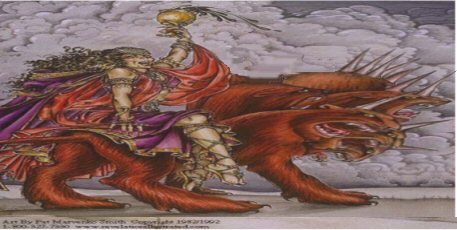
In the sense that the picture above at the top of this web page shows the woman
sitting on the back of the 7 headed, 10 horned scarlet beast, it is inaccurate in
some sense because in Revelation 17, the woman is said to be sitting on the 7 mountains/heads
(it is reasonable to interchange the word hills for mountains). At no point
in Revelation 17 is it stated that the woman is sitting on the back of the scarlet
beast. But, the picture does give some idea of what the vision is trying to
convey, so the writer uses it. Sorry about the inaccuracy, but it would be
difficult for an artist to portray the woman sitting on the 7 heads and also show
the 10 horns!
Who Are the 10 Horns?
Revelation 17 says that the 10 horns will give their power and authority to the
beast. Who are these 10 horns? Many think they are political leaders
or political entities such as 10 nations of Europe, but given that the beast itself
is predominantly a religious power (the Papacy), and knowing that the
Miller Principle, the
Similarity Principle, and the
Difference Principle
would apply here (principles that
DO APPLY
to beasts!), we can deduce the following about the 10 horns given the following
additional facts: (1) the woman has daughters that are prostitutes like her, and
(2) the 10 horns give their power and authority to the beast. Now, here is
how to understand who these 10 kings are.
The
Miller Principle
tells us that these horns have their days of dominant power during the third phase
of power represented on the beast by the body (phase 1), the heads (phase 2), and
horns (phase 3, see
the 3 phases of the beast). We know that the time represented by the
body is past history as of 1798 as that closed the first phase of power of the beast.
We also know that the heads are nearly done with their day of power (written during
November of 2002). The time of the 10 horns is almost here. So, we know
that their time is yet future. The
Similarity Principle
tells us that these 10 kings will be religious powers because they come out of a
religious power (the Papacy). The
Difference Principle
tells us that they will probably be smaller and weaker than what came before.
Now, one could say that this is somehow a further division of the Papacy's power,
but it turns out that the
Exception Principle
comes into play here. The statement that the 10 horns give their power to
the beast is the exception. Here it is telling us that somehow these horns
have become so different from the original power which they grew out of, that they
are not the Papacy or the Catholic Church itself, yet we must not forget that
because they are on the beast, they must be similar and must arise from it.
Now, given that the woman has daughters, we could ask ourselves a few questions.
Since the woman represents a church that has apostatized and she has daughters,
could it be that she has spawned daughter churches that have also apostatized?
What religious powers have come out of the Catholic Church in history? The
answer to this is pretty obvious if history is known to the reader. The answer
is that the
Protestant Churches
are what these daughters and 10 horns are all about. They are the only powers
that have come out of the Catholic Church that can match. For certain, the
Buddhists, the Confucianists, the Hindus, and even the Muslims cannot claim to fit
this. Only the Protestant Churches fit this prophecy. Now, heads can
be taken to represent leaders (secular or religious). So, as the heads on
the scarlet beast of Revelation 17 can represent the leaders of the Catholic Church
during the "is not" phase of the beast (1798 to the end of the 7 heads),
so also the 10 horns represent the leaders of Protestant Churches that have or will
apostatize and at some point in time in the future, will give their power and authority
over to the Catholic Church for accomplishment of a common purpose. So, it
is the leaders of the Protestant Churches who are the 10 horns.
What is the connection of the beast to the number 666?
The original discoverer of this connection relates that he was contemplating the
interpretation of the 666 number from Revelation 13:18 when the thought occurred
to him that the popes have numbers after their names, such as John Paul II.
He noted that the text in Revelation 13:18 was introduced by the phrase "Here is
wisdom" while the text in Revelation 17:9 says "And here
is the mind which hath wisdom". These phrases are nearly identical
in meaning, so he began to realize that this was telling the reader that there is
a connection between the number 666 and those 7 heads in Revelation 17. Knowing
that the beast itself was the papacy, he began to research this connection.
First he began by gathering a list of the popes, and then progressed to adding up
the numbers of all the popes. This came to a number much too large.
He thought on that for a while and wondered if the year 1798 might have something
to do with this because of the prominence of that year in prophecy and papal history.
So, he selected out the list of popes after 1798. About that point he noticed
that there were 7 such names when the numbers after the names are ignored.
This last discovery interested him because of the prophecy in Rev 17:9 - 11, which
says: And here is the mind which hath wisdom. The seven heads are seven mountains,
on which the woman sitteth. And there are seven kings: five are fallen, and one
is, and the other is not yet come; and when he cometh, he must continue a short
space. And the beast that was, and is not, even he is the eighth, and is of
the seven, and goeth into perdition. He began to realize the 7 kings were
in fact the 7 names occurring after 1798. Believing this to be possible, he
gathered a list of all the popes who ever reigned who were members of these 7 names
and then added up the numbers assigned to their names. This produced a total
of about 679. Much better, but still not correct.
Further research led him to realize that the text says to count or calculate the
number, so he began to wonder if counting was the correct way to do this.
He found that if you simply make a list of the popes for each name, count the popes
in each name, and then add up the count for each name, and finally add up the count
totals for all the names, the total comes to 665!
Now, here is where things begin to get really interesting. Further research
into the history of the 7 papal names occurring after 1798 revealed that from the
perspective of Pope Paul VI (1963-1978), 5 papal names had already died out, one
was at that time (Pope Paul), and there was one more yet to come who had never been
before - John Paul. So these elements of the prophecy matched exactly with
the history of the 7 names. More research by the writer revealed that for
each of the 7 papal names, if you add up the total number of years each papal name
has reigned, you find that the John Paul series is by far the shortest, which as
of the writing of this page in November of 2002 stands at 24 years. The next
closest one is about 67 years. So, this element of the prophecy matched as
well. What is even more interesting is that when the count of the popes is
added up, as of John Paul II it comes to 665.
See Papal Names Die Out Date Chart.
There are objections to the interpretation presented here based on the idea that
in Daniel 2 and 7, the visions there have explanations which always start with the
prophet Daniel's time, language, place, and empire he is in. Of course, they
forget that Daniel 8 does not start there also. But, they claim, this vision
in Revelation 17 must also be of John's time because the vision is followed by an
explanation which includes the statement "five have fallen, one is, and one
more is yet to come..." (Revelation 17:10). They conclude that the "one
is" must be John's time. This is a mistaken idea, though, because at
the beginning of the chapter, the explanation begins with the statement that John
is going to be shown the punishment of the woman. The vision is then shown.
But, the explanation has already started, and continues after the vision.
Again, the beginning of the explanation is about the punishment of the woman.
This is something that is clearly yet future, even by their definition because of
their statement that the "one is" is at the time of John. The woman's
punishment is after that event according to the chapter. The chapter clearly
does not start with John's time, especially given that the woman is the apostate
church which has not yet been punished even as of the writing of this web page in
November of 2002. So, their dating is way off.
So, it would appear that under their premises, the chapter backs up in time.
This is not impossible, but it makes better sense to consider that maybe the whole
chapter is dealing with events near the end of time, not at the time of John and
then forward towards the punishment of the woman. Further, under their premises,
they must place the scarlet beast prior to the time of John, for heads cannot exist
independent of the body and they claim that the 5th head is at the time of John.
This also ignores the clear evidence from Daniel (with no counterexamples from Daniel)
that heads on a beast are to be considered concurrent rather than sequential.
Their premises rule that out and clearly go against the rules laid down in Daniel.
Of course, some of those who believe this will try to say that the scarlet beast
is the dragon. That may appear logical but it ignores the clear evidence pointing
towards the papacy as being the scarlet beast. And, you still have the concurrency
problem. So, this objection should be put to rest by the facts.
The conclusions from this are profound and really amazing. This is telling
us that the next pope who has an assigned number of one (his name has never been
used before by any other pope), will in fact be the last pope ever. Sometime
during his lifetime, Jesus will come and end this world. We cannot know the
year, day or hour of his coming from this prophecy, and because of the possibility
of life extending scientific breakthroughs that might come in the next few years,
it is not even certain that we can tell what decade of this next pope's life this
will occur in, but of one thing you can be certain is that this world will end before
he can die a natural death. This is really an amazing prophecy.
Considering that the current pope is aged and has Parkinson's Disease (and the writer
does feel sorry for him on a personal level about that as the writer's father-in-law
suffered a lot from and died of complications of Parkinson's Disease) and is not
likely to live that much longer, we can know that the time of the 8th king is probably
not that far off. Further, consider that the likely replacements for John
Paul II are all in their 70s. This has profound implications for our world's
future, our personal lives in how they should be lived, and the religious world
as well.
Research by the writer has found that the method used by the discoverer of this
connection between the 666 number and the 7 heads of the scarlet beast of Revelation
17 closely parallels the method used by the Babylonians for calculating the number
666.
See the history of the 666 number for more information. They simply counted their gods and then added
up the count (which was: 1+2+3+4+...+35+36 = 666). In like fashion, the discoverer
simply added up the total of the counts of the 7 papal name lines and it totaled
to 665. Because of the inclusion of the Babylonian worship practices into
the Christian religion, it is to the religion that did this that the number 666
applies. There can be no other meaning, for to apply any other meaning is
to divorce the actual history of this number from the facts of history of the Christian
Church.
The typical method employed for calculating the number 666 has been through what
is called gematria, or assigning a numerical value to each of the letters in a name
(based on the Roman numeral system), and then adding up the numbers translated from
the letters contained in a name. For example, one of the titles that the popes
used to claim is Vicarius Filii Dei (which roughly translated means Vicar of God).
This number can be run through using the rules of gematria and it does add to 666.
There are a number of other such similar results found with the papacy, the Catholic
Church, and even some of the names associated with Italy.
Click here for a web page that explains in detail the gematria system.
Note that the web page I just referred you to has a lot of other information on
it, including some on the history of the number 666, much of it quite interesting.
But, none of the other methods such as the gematria system, employs the original
method used by the Babylonians, which means they are historically inaccurate and
therefore of suspect value. Further, many individuals' names add to 666 under
the gematria system. Should they be called the 8th king too? I think
not.. One last point about this is that the alphabet system we who speak English
or many European languages use is only one of more than 30 in use in the world today.
What about those who use an alphabet where Roman Numerals cannot be assigned because
there are no equivalent Roman alphabet letters that can be assigned a numerical
value? Must they be denied knowledge of this because of that quirk in history
which gave them the "wrong" alphabet? However, counting and adding
is valid in all languages and is not alphabet dependent. That gives virtually
every person in this world access to this information as the rules of arithmetic
are not language or alphabet dependent.
The number 666 as applied by this web site tells us that God knew all the details
of the popes from the beginning. That should give us confidence in him that
he can see us through to heaven.
There are those who wonder about the connection between the 7 kings and the 7 heads,
or in other words, are the 7 heads the 7 kings? Remember that from Daniel
2, 7, and 8, we learn that heads can represent names (see Daniel 2:38 which
says "...Thou art this head of gold.", which puts a name to that head), kings, nations,
and so on. So, the 7 kings are in fact stand-ins for the 7 heads. They
are synonymous or one and the same. This is not contradicting the statement
in Revelation 17:9 which says that the 7 heads are 7 mountains. It merely
is making all of them equivalent. From Daniel, heads = kings, and from Revelation
17, kings = mountains, so the conclusion is: heads = kings = mountains.
But this applies only to the 7 kings, not the 8th king. The 8th king is a
king indeed, but the equivalency to mountains does not apply as it does not say
that it does. Let's not read into the text what is not there. Further,
the 8th king is said to be of the 7 (Revelation 17:11). The writer does not
read Greek, but from somebody who does, it was relayed that the construction of
this statement in the original Greek probably indicates this is saying that the
8th follows in sequence with the 7th. So, that means it is likely that the
8th king will come immediately after the 7th, which is the John Paul series.
Given that the count currently stands at 665, this means that the days of the 7
heads will be finished when John Paul II dies. That is because there is only
a count of 1 needed to fill out the number to 666, which can be done by one single
pope with a name that has never been used before in history. The election
of the pope with a count of one to his name will begin the time of the 10 horns.
Some have suggested that the phrase indicating that the 8th king is said to be of
the 7 (Revelation 17:11) means that the 8th must be some sort of resurrected member
of the 7 kings. This, suggests that somehow one of them comes back or is literally
resurrected to become the 8th king. But the context would suggests otherwise.
The 8th king is NOT said to be a mountain, meaning that his name is unique.
It seems extremely unlikely that any returning 7th king would take a different name
than he already has, especially since he would be recognized, so consequently that
argues against the 8th being a literally returned member of the 7 kings. Further,
to literally be from one of the 7 kings, he would have to be resurrected from the
grave, for all members of the 7 kings have in fact died in order to leave office.
This would also require the intervention of God, for only God can resurrect a person
from the grave. Do you really think he is going to do such a thing?
Would that not make him part of genuinely creating evil, which he will not do?
For this and other reasons, it is unreasonable to believe that the 8th is literally
part of the 7 kings, but rather this phrase indicates what the Greek suggests -
he follows in sequence the 7th king which also tells you he is different from the
first 7.
A Strange oddity of the Number 666 and the 8th king
Consider that there are eight kings listed in Revelation 17. Seven as a group
as the heads, and then one more. Now, the number 666 will apply to the eighth
king when he arrives. What is interesting is the following observation:
1 + 2 + 3 + 4 + 5 + 6 + 7 + 8 = 36
The sum of 1 to 36 = 666
The eighth king, when his number is added to the count of the other seven, totals
36, and the sum of the number 1 to 36 equals 666. This might be another way
of showing us that the eighth king gets the number 666, for only the eighth king
produces the sum of 36, which can in turn produce the total 666. Interesting
indeed. Thus, when his total is added to that of the 7, it makes both the
number 36 and 666. This information regarding the numbers 1 to 8 and 1 to
36 summed was sent to the author by an astute observer of Bible prophecy matters
who found this quite interesting.
The 10 Horns and the Return of the Beast
During the time of the 10 horns, expect to see the power of the Protestant Churches
grow. Also, sometime during the time of the 10 horns, these powers will give
their power back to the beast so as to accomplish a common goal. That means
the beast is going to return when they do this. Remember that the original
beast had 2 powers originally given to it in 538 AD that created the beast in the
first place. These powers were the right to punish heresy and power over all
other bishops, or in other words, the pope was the supreme bishop. Therefore,
when the protestant churches give back those same powers, this would constitute
the return of the beast and will make the beast dominant over the 10 horns once
this event has occurred. This constitutes at least part of the process of
formation of the image beast.
Note the following:
Rev 17:12 And the ten horns which thou sawest are ten kings, which have received
no kingdom as yet; but receive power as kings one hour with the beast.
Rev 17:13 These have one mind, and shall give their power and strength unto
the beast.
Rev 17:14 These shall make war with the Lamb, and the Lamb shall overcome
them: for he is Lord of lords, and King of kings: and they that are with him are
called, and chosen, and faithful.
Now, the phrase "but receive power as kings one hour with the beast"
would strongly suggest that they will receive political power. That is only
logical because they have religious power already (since both are primarily religious
powers), so to say they receive power is redundant unless it is telling you they
receive another kind of power, most likely political power. But, notice it
says the 10 horns "shall give their power and strength unto the beast."
This means the beast returns at that time because both will have political power
already, and from the 10 horns the beast will get power over other bishops, which
would be the protestant bishops.
Some would argue that the 10 horns give their power to the beast immediately upon
receiving it, but the author thinks that unlikely, though not impossible.
Do consider that it usually takes some time to build political power, so this is
not likely to be an overnight event. So, for that reason, it seems likely
that the building of political power, which both the beast and the 10 horns engage
in, must occur over over a period of time. It seems very likely that sometime
after they begin to build their political power base, the 10 horns give their power
to the beast. That event is a return of the powers that the beast originally
had. The beast originally was given power to punish heresy and power over
other bishops. To punish heresy necessitated some political power because
it meant the church had to use the power of the state to do that. The thirst
for religious power made this absolutely necessary. But, in the future, giving
the beast and the 10 horns political power returns only one of those powers the
beast was originally given. This would certainly be the process of the beast
ascending out of the abyss. The other is to give the beast power over all
other bishops. This last step restores the papacy to the full powers it originally
had during the 1260 prophetic days from 538 AD to 1798, so this constitutes the
actual return of the beast from the abyss. Obviously, the 10 horns also hand
over their political power as well.
What about the anti popes?
Do they count too?
It is known from history that some of the popes were not official. They claimed
to be popes when they had not been officially elected, or there were other problems
with their claims of office. These are called anti popes, and their
number is usually not counted by Catholic officials. When that happens, their
number is assigned to the next pope to take the same name. Any pope who is
"fired" (deposed might be a better word for this) usually has his number
given to the next pope who takes the same name. So, as a consequence of these
facts, what we can know is that the next pope with a count of 1 (his name has never
occurred before in papal history) will be the 8th king. If there is a pope
after John Paul II who has a count greater than 1 (his name has occurred before
in papal history), then this understanding of the prophecy will be incorrect
only
if he dies in office or according to their rules is legitimate after leaving office
in some way other than death. If he is deposed, then he will very likely not
be counted. So, the next pope with a count of 1 (his name has never occurred
before in history) should be the 8th king as this pope would complete the count
to 666. We'll be watching with great interest to see what happens. But
given that the 8th is evidently to occur in sequence with the 7th, we don't think
there is likely to be an intervening pope that would have to be deposed, but we
cannot rule that out entirely.
The writer has heard from some individuals who claim that some of the anti popes
should be counted so that it throws the count off. Because we don't count
them, they claim that our count is inaccurate and contrived. The problem with
that approach is that it denies the Catholic Church the right to decide who is official
and who is not. We as voters of the United States of America would not stand
for some other country to decide who our official presidents are would we?
Of course not! The point is that political and religious organizations have
the right to decide who their official leaders are and are not. The Catholic
leaders have the right to decide who the popes and anti popes are. Those outside
of their official circles do not have that right. Therefore, the official
papal list is used by this web site for determining who is included on the list
and who is not.
Click here if you would like to see a list of all the popes, with the 7 papal names
occurring after 1798 clearly marked out in color. You can find the original official list at
the
Catholic Encyclopedia Web Page. Introductory information about that list
on the Catholic Encyclopedia Web Page is available
here. They won't have a color coded list of the 7 papal names
after 1798, so our list might be easier for you to find the individuals who are
among the 7 names.
What About The Mountains? How are they connected to the 666?
Revelation 17:9 says "...The seven heads are seven mountains...".
The term "mountains" is used in Jeremiah 51:25, which says "Behold,
I am against thee, O destroying mountain, saith the LORD, which destroyest all the
earth: and I will stretch out mine hand upon thee, and roll thee down from the rocks,
and will make thee a burnt mountain". This is a statement made by God about
Babylon. Babylon had what was called the hanging gardens, which was believed
by some to have been built to resemble a mountain when seen from a distance.
That may or may not have been so, but what is known is that the Babylonians built
ziggurat structures as worship centers as part of their pagan religion. These
were intended to resemble mountains. The following is relevant to this discussion:
"The Dictionary of Symbolism" by Hans Biedermann page 228 states:
"The ziggurat structures of ancient Mesopotamia were architectural translations
of DIVINE MOUNTAINS; the mountain is the abode for the gods."
The reader should remember that the Babylonians worshipped at least the 37 main
gods, so a mountain designed to be an abode for the gods should be understood to
have been an abode for multiple gods. They had 37 of them to house and they
were trying to create an abode for all of them when they built the ziggurats.
This use of "mountains" in Revelation 17 is intended to tell us something
analogous, that each head, which represents a name and is equated to a mountain,
is representative of multiple individuals. So,
the eighth king, who is not equated to a mountain, is a single individual.
He is not said to be a head, though as a king he certainly
could
have been equated to one.
Yet he is not, so he cannot be equated to a mountain. People often make
the mistake of assuming something that is neither implied nor explicitly stated
in scripture, especially with regards to prophetic interpretation, but it is important
not to do that here. Consequently, you cannot assume that the 8th king must
be a head or mountain. He is neither, but is a king only. Therefore,
in contrast to the others, he is singular, which means he is one individual only.
Each of the seven heads is a papal name, each of which is also a mountain and which
contains multiple individuals, all with the same name but different count numbers.
The 8th king is neither a head nor a mountain and therefore does
NOT
contain multiple individuals with the same name. So, in contrast to the 7
heads, the 8th king must represent a papal name different from all previous papal
names. If his name was in common with another previous pope (meaning there
would be 2 or more names that he would be part of), then he would have been said
to be not only a king, but also a head and a mountain. Does this make sense?
Given that the next pope with a count of 1 will complete the count to 666, this
also implies that the 8th king's name must be one that has not occurred before so
that his count will be 1. All popes who choose a name which has never been
used before have a count of one.
Perhaps an example will help the reader understand this better. Take the papal
name of John Paul. As it happens there have been 2 popes with that name, John
Paul I and John Paul II. The two of them make up a "mountain" which
clearly contains more than one individual. Remember that the Babylonian "mountain"
contained all their gods. The 8th in contrast to this "mountain"
is said to be neither a mountain nor a head, but will be only a king. Now,
clearly that should show that the 8th contains only one person. Since it contains
only one person, it implies that his name cannot have occurred before in papal history,
for if his name had occurred before in history, he would become a mountain with
more than one person in that mountain. Does this help you understand this?
Hopefully so.
Now, the point of this little exercise is to help the reader understand that the
apparent artificial division of heads by names among the popes is in fact intended
by God. He is here telling the reader that each of the heads represents a
group of individuals, and that there are 7 such groups. Since heads can be
names and history shows us that there are in fact 7 papal names since 1798, it is
clear that this symbolism is intended to convey to us that the 7 papal names are
the 7 heads that each contains multiple individuals. There is no precedent
in the history of the world's monarchs to divide kings into groups by name (except
for the convenience of numbering them, such as the King Henry series of the British
Throne) and then add up their count, to be sure (which makes sense as they usually
are a genetic line of individuals so a division by name would not make much sense),
but God is trying to show us that he wants us to do just that.
Another approach can be taken. Heads can be taken to also represent the leadership
of any power (Daniel shows that heads can be symbolic of the office of king, who
is a leader of his nation). Who are the heads of the Catholic Church?
Everybody should know the answer to that question: the popes, of course. Since
the beast represents the papacy and the heads represent divisions of the beast's
power that occur after 1798 and they can also represent the leadership of a power,
this tells us that those heads must be the popes occurring after 1798 because they
are the leadership of the Catholic Church. The equating to mountains tells
us that they are to be separated into 7 groups, each of which contains multiple
individuals.
The Babylonians were counted by God as one mountain (see Jeremiah 51:25) so all
their gods are to be grouped as one. Within that one mountain, the Babylonians
counted their gods and added up the numbers like this:
1 + 2 + 3 + 4 + 5 + 6 + 7 + 8 + 9 + 10 + 11 + 12 + 13 + 14 + 15 + 16 + 17 + 18
+ 19 + 20 + 21 + 22 + 23 + 24 + 25 + 26 + 27 + 28 + 29 + 30 + 31 + 32
+ 33 + 34 + 35 + 36 = 666
But, in Revelation 17 it tells us there are 7 heads which are 7 mountains and also
7 kings. Revelation 13 tells us the sum is 666. Now, this is telling
us the instructions of how to calculate the sum and what the sum should total to.
It is telling us there are 7 groups, there are multiple individuals within each
group, within each group the individuals are to be counted and a sum calculated
from the count. Logically, to complete the total, one would need to then total
the sums of all 7 counts. So, if you know how the Babylonians viewed mountains
and how they added up the god numbers to calculate the total, then you can see that
the instructions are all there in the bible in coded form. All you needed
is a little more information from history (which I have provided) to solve this
puzzle!
The 7 papal names divide up the individuals making up the popes occurring after
1798, and their count numbers are to be added up within each group or mountain,
and the total for all 7 groups should then be totaled. Here is a quick overview
of how all 7 mountains are added up for comparison to the Babylonian one mountain
method:
Mountain #1. Pius 1 + 2 + 3 + 4 + 5 + 6 + 7 + 8 + 9 + 10 + 11 + 12 =
78
Mountain #2. Leo 1 + 2 + 3 + 4 + 5 + 6 + 7 + 8 + 9 + 10 + 11 + 12 + 13 =
91
Mountain #3. Gregory 1 + 2 + 3 + 4 + 5 + 6 + 7 + 8 + 9 + 10 + 11 + 12 + 13 + 14
+ 15 + 16 =
136
Mountain #4. Benedict 1 + 2 + 3 + 4 + 5 + 6 + 7 + 8 + 9 + 10 + 11 + 12 + 13 + 14
=
105
Mountain #5. John 1 + 2 + 3 + 4 + 5 + 6 + 7 + 8 + 9 + 10 + 11 + 12 + 13 + 14 + 15
+ 16 + 17 + 18 + 1 9 + 20 + 21 =
231
Mountain #6. Paul 1 + 2 + 3 + 4 + 5 + 6 =
21
Mountain #7. John Paul 1 + 2 =
3
78
+
91
+
136
+
105
+
231
+
21
+
3
=
665
Now, the eighth king should have a count of 1, to complete the total to
666.
Do you see that equating the heads to mountains is telling us that we are to add
up the count numbers within each mountain? This alone is telling us that we
are to do the summation as done above. The Babylonians added up the numbers
of their gods within one mountain, but here we have 7, so must add up the count
numbers within each mountain. Therefore, this is an instructional device giving
us information about how to do the arithmetic. In contrast, it also gives
us information about the 8th king, that he is alone and not part of a larger group.
Please note that the assignment of papal names to any given mountain number is purely
arbitrary. The name John could have been assigned to mountain #1. We
only know that these names are what each of the mountains represents, but no mountain
number can definitively be assigned to most of them. They are assigned here
to help the reader better understand what is the relation between mountains, each
of the papal names, and the count summation. Clearly it is true that the John
Paul series occurs after the first 6 names, so it could be said to be the last or
7th head or mountain. But, this is one of only two heads or mountain that
can be assigned a number because the other names continue to exist together from
1798 until the last member of each name line dies (the other is the 6th head, which
the details given clearly refers to the name of Pope Paul). Remember that
the heads are the 7 names without the assigned numbers, not the 15 or so individual
popes that have been in office starting in 1798. The names continue to exist
together while individual popes for each name do not. If this idea proves
difficult to understand, think of the names as membership lists to which individual
popes belong.
This information about the mountains shows that they are helping define more information
about the heads, but are in fact essentially the same thing. One adds them
up just like the heads.
If you refuse to accept the division by names, how are you going to divide them
7 ways? By what criteria do you divide them? There really is no other
good way to do it. And remember that history is usually your best guide
on how to interpret things like this in prophecy. So, you'll have to find
something else in history to match these 7 divisions that occur after 1798 with
the popes. Oh, and don't forget that it must conform to bible definitions
of what heads can represent and the rules of interpretation. Good luck - you'll
need a lot of it. For an example of how difficult it can be to find some other
interpretation, consider that these 7 heads might represent 7 sequential time periods
of the papacy since 1798. The problem is that violates the Concurrency Principle.
Those heads are concurrent, not sequential. So, you're back to looking for
another hypothesis again!
Hopefully this clarifies the reader's understanding of the connection of the number
666 to the beast and the heads.
But....and More Objections
There are objections to the interpretation presented here based on the idea that
in Daniel 2 and 7, the visions there have explanations which always start with the
prophet Daniel's time, language, place, and empire he is in. Of course, they
forget that Daniel 8 does not start there also, so one cannot conclude that a rule
has been established by Daniel 2 and 7. But, they claim, this vision in Revelation
17 must also be of John's time because the vision is followed by an explanation
which includes the statement "five have fallen, one is, and one more is yet to come..."
(Revelation 17:10). They conclude that the "one is" must be John's time. This is a mistaken
idea, though, because at the beginning of the chapter, the explanation begins with
the statement that John is going to be shown the punishment of the woman.
The vision is then shown. But, the explanation has already started, and continues
after the vision. Again, the beginning of the explanation is about the punishment
of the woman. This is something that is clearly yet future, even by their
definition because of their statement that the "one is" is at the time
of John. The woman's punishment is after that event according to the chapter.
The chapter clearly does not start with John's time, especially given that the woman
is the apostate church which has not yet been punished even as of the writing of
this web page in November of 2002. So, their dating is far off the mark.
So, it would appear that under their premises, the chapter backs up in time.
This is not impossible, but it makes better sense to consider that maybe the whole
chapter is dealing with events near the end of time, not at the time of John and
then forward towards the punishment of the woman. Further, under their premises,
they must place the scarlet beast prior to the time of John, for heads cannot exist
independent of the body and they claim that the 5th head is at the time of John.
This also ignores the clear evidence from Daniel (with no counterexamples from Daniel)
that heads on a beast are to be considered concurrent rather than sequential.
Their premises rule that out and clearly go against the rules laid down in Daniel.
Of course, some of those who believe this will try to say that the scarlet beast
is the dragon. That may appear logical but it ignores the clear evidence pointing
towards the papacy as being the scarlet beast. And, you still have the concurrency
problem. So, this objection should be put to rest by the facts.
Another objection raised is that this method is said to be inconsistent because
the 7 papal names from 1798 onward are used and therefore one should use only the
numbers of the popes occurring after 1798 as well. Factually, the prophecy
does limit the selection of the
names
to those occurring after 1798, but it does not limit membership in those name lines
to 1798 onward. Nothing in the prophecy indicates that should be done.
If it did, certainly this factor would be included and it would considerably reduce
the count total. The heads are names, that much we know, and it must be the
names occurring after 1798. But, nothing indicates that the names also means
those individuals within the names from 1798 onward are the only ones to be considered.
Remember that the heads are really stand ins for membership lists of pope names.
This does not in any way mean that the only members in the list are those popes
occurring after 1798, but rather is telling us that there are 7 membership lists
with names such as Paul, John Paul, and Benedict. These are the ones to be
used and that all in that membership list are to be included. It does not
by any means indicate that the individuals inside that membership list are to be
restricted to 1798 onward.
Consider the Babylonian gods. They counted all their gods starting from one,
beginning with the first god. It would not make sense to omit some of the
individual popes from prior to 1798 and then count the remaining ones because then
the count would be incomplete. The entire set within the same group should
be included, just as all the gods within the Babylonian "mountain" were
counted. After all, God did say that the 7 heads are 7 mountains. He
did NOT say the 7 heads are 7 half mountains (or something to that effect, meaning
to omit all individuals before 1798).
Links